
Most homeowners notice the outside of the roof first. Fair enough. Shingles, metal panels, cedar, or a flat roof membrane are the parts you can see from the street. But that visible roof covering is not the whole roof. Under it, there are hidden layers that help shed water, protect the roof deck, and deal with weak spots around valleys, eaves, chimneys, skylights, vents, and other penetrations. One of those hidden layers is roof underlayment.
At Marks Roofing, this is one of the roof system details we like to explain before a roof replacement starts. Not because every homeowner needs to become a roofer. They don’t. But because underlayment affects the roof in ways that are easy to miss once the final material is on.
Quick Answer: What Is Roof Underlayment?
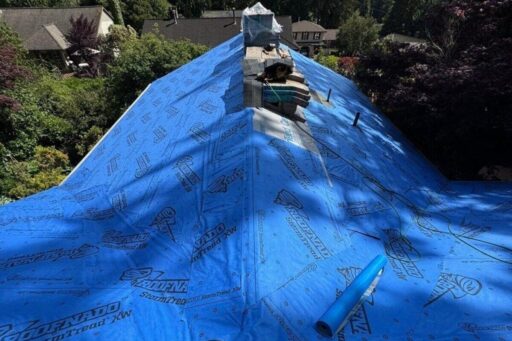
On a sloped roof, it usually goes over the plywood or OSB sheathing and under the shingles or metal roofing. Homeowners may hear different names for it: roofing underlay, felt paper, synthetic membrane, or ice and water shield, depending on the material and where it is used.
Its job is not to replace the finished roof covering. This layer works as backup protection if moisture gets under the visible roofing because of wind-driven rain, vulnerable roof details, installation gaps, or temporary exposure during the job. So, if you are asking what goes under roof shingles, the plain answer is this: roof deck first, protective underlay next, then the finished shingle system. IKO’s shingle installation guide also explains this layered order, including deck preparation, drip edge, ice and water protection, roof underlayment, and shingles.
This matters because the layer disappears after installation. Once shingles or panels go on, homeowners usually cannot see whether the right material was used, whether vulnerable areas received extra protection, or whether the work was done cleanly.
That is why it should be discussed before the roof is covered.
Why Roof Underlayment Matters More Than Homeowners Think
A roof is not waterproof because of one material. It works because several layers are arranged to shed water, redirect water, and protect the structure underneath. Shingles, for example, are made to shed water down the roof. They are not a sealed plastic lid over the house. Strong wind, roof shape, worn materials, bad flashing, ice, debris, moss, or slow-drying areas can all change how water behaves on the surface.
Underlayment gives the roof deck a secondary water barrier if moisture gets past the outer covering. It can help reduce the chance of small leaks reaching the sheathing, but it is not a permanent exposed roof and does not make poor flashing or weak installation harmless.
The value shows up most clearly in real roof conditions:
- Rain can blow sideways under edges.
- Valleys carry more water than open roof planes.
- Eaves can face water backup, ice, and gutter-line moisture.
- Chimneys, skylights, and vents interrupt the roof surface.
- Low-slope areas drain more slowly.
Older roof decks may have soft or damaged sections that need attention before new materials go on.
For homeowners in coastal British Columbia, underlayment matters because heavy rain, wind-driven rain, moss, shade, and slow-drying roof areas can put extra pressure on the roof system. The visible roofing does most of the water-shedding, but the hidden layers help when conditions are less forgiving.
Underlayment also affects the quote. Two estimates may both say “new roof,” but one may include basic felt while another includes synthetic underlayment plus ice and water shield at valleys and eaves. That is why homeowners should ask what underlayment is included, where extra protection will be used, and whether the materials match manufacturer requirements.
Main Types of Roof Underlayment
There are several products on the market, but most homeowner conversations come down to three practical categories: felt, synthetic membrane, and ice and water shield. They are not interchangeable. Felt is the traditional roof underlay, synthetic products are a newer sheet material, and ice and water shield is a self-adhered membrane usually used in higher-risk areas rather than across the entire roof by default.
The right choice depends on the roof material, slope, roof design, local weather, manufacturer instructions, and the written project scope.
| Warranty Type | What It Usually Covers | What Homeowners Often Misunderstand |
|---|---|---|
| Manufacturer warranty | Roofing material defects, based on written terms | It may not cover labour, tear-off, disposal, leaks, or outside damage |
| Workmanship warranty | Installation errors by the roofing contractor | It usually does not cover product defects, storm damage, or later work by others |
| Extended or system warranty | Broader coverage for an approved roof system | It may require certified installation, registration, and compatible products |
| Limited lifetime warranty | Coverage based on the written meaning of “lifetime” | “Lifetime” does not always mean full coverage forever |
| Transferable warranty | Coverage that may move to a new homeowner | Transfer may require paperwork, deadlines, fees, or approval |
Felt underlayment
Felt underlayment is the older, familiar roof underlay many homeowners know as “felt paper.” It is usually asphalt-saturated and has been used under shingles for a long time. Its job is simple: create a water-resistant layer between the roof deck and the finished roof covering.
The limitation is handling and exposure. Felt can wrinkle, tear, absorb moisture, or become harder to work with when weather conditions are poor. It can still be suitable in some roof systems, but it needs proper installation and should not be treated like a heavy-duty waterproof membrane.
For a homeowner, the main point is this: felt is not “wrong” by default. It just needs to match the roof, the conditions, and the written scope of the job.
Synthetic underlayment
Synthetic roof underlayment is common on modern roof replacements. It is usually made from engineered sheet materials rather than traditional asphalt-saturated felt. Roofers often like it because many products are lighter, stronger, more tear-resistant, and easier to handle across larger roof areas. Some also offer better temporary exposure resistance than basic felt, depending on the manufacturer.
But synthetic does not mean problem-proof. It still needs correct fastening, proper overlap, clean installation, and attention to product exposure limits. If the material gets torn, wrinkled, loose, or overexposed, it should be checked before the finished roofing goes over it.
Homeowners sometimes confuse this type of roof underlay with ice and water shield. That is a mistake. Synthetic products usually act as a water-shedding backup layer, while ice and water shield is a self-adhered membrane used for stronger protection in specific areas.
Ice and water shield
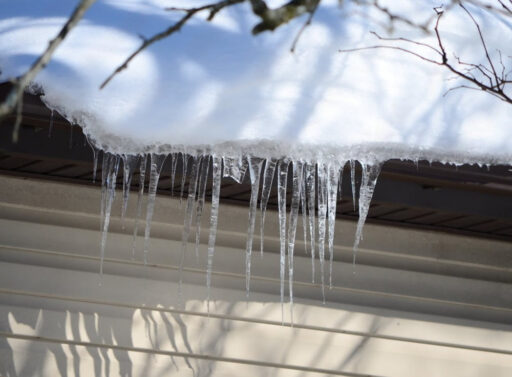
This self-adhered membrane sticks directly to the roof deck and can help seal around fasteners better than standard underlayment. Roofers often use it in vulnerable areas where water movement, slow drainage, or leak risk is higher.
Roofers often use it in vulnerable areas such as valleys, eaves, around penetrations, skylights, chimneys, and sometimes low-slope transitions. These areas tend to see more water movement, slower drainage, or more leak risk. That does not mean every roof should automatically be covered entirely with ice and water shield. In some designs, full coverage may make sense. In others, it may not. Roof material, ventilation, slope, local conditions, and manufacturer requirements all affect that decision.
The practical homeowner takeaway is this: ask where ice and water shield will be used and why. A clear answer should connect the material to real roof conditions, not just say “extra protection” with no detail.
Where Roofers Use Extra Protection
Underlayment is not always used the same way across the whole roof. Some areas need more attention because water behaves differently there. Open roof planes usually shed water in a fairly predictable direction. Valleys, eaves, roof-to-wall transitions, chimneys, skylights, and vents are different. They interrupt the roof surface or collect more water.
Roofers usually pay closer attention to these areas during replacement:
| Roof area | Why extra protection is used | What roofers usually consider |
|---|---|---|
| Valleys | They carry concentrated water from two roof planes | Valley design, slope, water volume, underlayment, and flashing details |
| Eaves | Water, ice, and gutter-line moisture can create backup risk | Ice and water shield placement, drip edge, and drainage |
| Chimneys | The roof surface meets masonry and flashing details | Step flashing, counterflashing, underlayment tie-in, and water flow |
| Skylights | Openings in the roof plane increase leak risk | Curb condition, flashing kit, membrane details, and slope |
| Vents and penetrations | Pipes and vents create holes through the roof system | Flashing condition, seal points, and underlayment integration |
| Roof-to-wall transitions | Water can collect or redirect along walls | Flashing, membrane support, siding details, and drainage path |
| Low-slope areas | Water drains more slowly | Material suitability, slope, membrane choice, and manufacturer guidance |
This is where workmanship matters. The protection has to match the roof detail. A valley may need stronger membrane protection because water gathers there, while a chimney or skylight may need proper flashing as much as underlayment. Low bids can differ here too. One quote may just say “underlayment,” while another explains synthetic underlayment, ice and water shield at valleys and eaves, and treatment around penetrations. Those hidden differences matter during the project.
Underlayment for Shingles, Metal Roofs, and Flat Roofs
Not every roofing material uses the same setup underneath. That is why “best roof underlayment” is not a one-product answer. The roof covering, slope, deck condition, manufacturer instructions, and local weather all affect what should be used.
For asphalt shingles, this layer is usually part of the standard shingle roof assembly. Felt or synthetic products may be used, with ice and water shield often added in vulnerable areas. For metal roofs, the choice can be different. Metal panels expand and contract, and some systems may need a material that handles heat, condensation risk, and manufacturer-specific compatibility. For flat roofs, the setup changes again. A flat roof may involve a membrane system, substrate preparation, insulation, drainage, and edge details, so the protective layers depend on the specific roof system.
| Roofing material | Underlayment concern | What should be confirmed |
|---|---|---|
| Asphalt shingles | Standard underlayment plus extra protection at vulnerable areas | Felt or synthetic underlayment, ice and water shield locations, manufacturer approval |
| Metal roofing | Heat, condensation, panel movement, and system compatibility | Correct underlayment type, temperature rating if needed, and manufacturer requirements |
| Flat roofing | Membrane system, substrate condition, drainage, and roof assembly design | What layers are included, how the substrate is prepared, and how water will drain |
A homeowner does not need to choose these materials alone. That is part of the roofer’s job. But they should expect the approach to be explained clearly.
If you are comparing an asphalt shingle roof replacement, metal roof replacement, or flat roof replacement, underlayment should not be treated as a vague line item. It should connect to the roof material and roof design.
Can Roof Underlayment Get Wet?
Roof underlayment can handle some temporary exposure, but not without limits. It helps with dry-in protection if rain shows up before the finished roofing is installed, but it is still not the finished roof. Manufacturers set exposure, fastening, and installation limits. Synthetic underlayment may handle exposure better than felt, and ice and water shield behaves differently because it sticks to the deck, but every product has limits.
The key question is not only “Did it get wet?” The better questions are:
- How wet did it get?
- How long was it exposed?
- Did it wrinkle, tear, loosen, bubble, or lift?
- Was it exposed beyond the product limit?
- Did water get underneath it?
- Will it dry properly before being covered?
Wet underlayment should be checked before roofing goes over it. If it is flat, fastened, within product limits, and not damaged, it may be manageable. If it is torn, saturated, loose, or overexposed, it may need correction. In rainy climates, some roof areas hold moisture longer, so dry-in planning matters.
| Wet underlayment issue | Why it matters | Possible next step |
|---|---|---|
| Light temporary rain | Many products can handle some exposure within limits | Check product condition before covering |
| Wrinkled underlayment | Wrinkles can affect roofing material placement and water-shedding | Flatten, repair, or replace as needed |
| Torn underlayment | Tears can let water reach the roof deck | Repair or replace damaged sections |
| Loose underlayment | Wind or poor fastening can reduce protection | Refasten or replace affected areas |
| Overexposed underlayment | UV and time can affect product performance | Review manufacturer limits before covering |
| Water under the underlayment | Moisture may be trapped against the deck | Inspect deck and allow proper correction before roofing continues |
The safest professional answer is not “rain never matters” or “rain always ruins it.” It depends on the product, condition, exposure time, roof design, and contractor inspection.
What Homeowners Should Ask Before a Roofing Project
Homeowners do not need to choose the underlayment themselves. That is the roofer’s job. But they should understand enough to ask what is included before the roof is covered. At Marks Roofing, we find these questions help prevent confusion and make roofing quotes easier to compare.
Here are practical questions to ask:
| Question to ask | Why it matters | What answer to look for |
|---|---|---|
| What type of underlayment is included? | “Underlayment” can mean felt, synthetic, or other materials | A clear material type, not a vague answer |
| Where will ice and water shield be used? | Vulnerable areas often need stronger protection | Valleys, eaves, penetrations, skylights, chimneys, or other risk areas as appropriate |
| Is the underlayment approved for this roofing material? | Compatibility can affect performance and warranty expectations | A product that matches manufacturer guidance |
| What happens if rain hits the underlayment? | Weather can affect timing and dry-in planning | A clear plan for checking wet or exposed underlayment before covering |
| How long can the underlayment be exposed? | Exposure limits vary by product | An answer based on the product, not a guess |
| Will damaged or soft roof sheathing be addressed? | Underlayment cannot fix a weak deck underneath | Inspection and replacement process if damaged decking is found |
| Will photos be provided before the roof is covered? | Hidden layers disappear after installation | Photo documentation of deck condition, underlayment, and vulnerable areas |
These questions are about understanding the scope, not challenging the roofer. A simple shingle roof may not need the same underlayment setup as a roof with valleys, skylights, dormers, or low-slope sections. The quote should also explain what happens if damaged roof decking is found after tear-off. Underlayment cannot make soft or rotten sheathing strong, so homeowners should confirm that the material matches the roofing system, slope, manufacturer instructions, and warranty expectations.
Quick Recap: Roof Underlayment in Simple Terms
Roof underlayment is the hidden layer between the roof deck and the visible roofing material. It helps protect the sheathing if moisture gets past shingles, metal panels, or other roof coverings. It is not the finished roof, and it does not replace proper flashing, good installation, or a sound roof deck.
The main options are felt, synthetic roof underlay, and ice and water shield. Felt is the traditional choice, synthetic products are common on many modern roof replacements, and ice and water shield is a self-adhered membrane often used in vulnerable areas like valleys, eaves, chimneys, skylights, vents, roof-to-wall transitions, penetrations, and low-slope sections.
The right setup also changes by roofing material. Shingles, metal roofing, and flat roof systems do not always use the same approach, so manufacturer-approved materials, roof slope, roof design, and compatibility all matter. For homeowners, the best move is simple: ask what is included, where extra protection will be used, how rain exposure is handled, and whether the selected materials match the roof system.